The Voting System That's Too Good for Politicians to Allow
The video explains that the Single Transferable Vote (STV) system creates a more representative government by allowing citizens to rank local candidates in multi-winner districts.
Discussions, Information and Ideas from across the UK and around the World
Understanding the UK's economic landscape and those who shape it requires looking beyond the headlines.
If we listen to the same few mainstream media outlets, we’re essentially looking at the world through a tiny keyhole. To really see what’s happening with the UK economy, we have to step outside that bubble and listen to real people from all walks of life, whether it's a shopkeeper on a struggling high street, a nurse, or an independent researcher. These are the people feeling the effects of the economy every day. When we open our ears to a broader range of experiences, the "official" version of events starts to look a lot more like a script and a lot less like the full truth.
The key is to stop taking things at face value and start asking questions. Every time a narrative is pushed hard, we should be thinking about the motives behind it. Those in power and those desperate to gain power rarely trot out information for our benefit. They often want to keep things exactly as they are or steer us in a specific direction.
By questioning everything and looking at who actually benefits from the current system, we stop being passive audience members and start thinking for ourselves.
The video explains that the Single Transferable Vote (STV) system creates a more representative government by allowing citizens to rank local candidates in multi-winner districts.
Using the case of Banksy's public artwork being privatised for profit, this video argues that free-market capitalism and the "tragedy of the commons" theory are socially constructed narratives weaponised by the wealthy to justify enclosing public goods and destroying community value.
This video analyzes a recent CNBC interview where Jeff Bezos argues for cutting taxes on average earners and reducing government spending rather than raising taxes on the super-rich, framing it as a misleading distraction designed to protect billionaire wealth from the growing wealth tax movement.
This video details how crude oil drives the global economy and shapes geopolitics, tracing its history from the 1974 petrodollar system to the US shale boom, while highlighting how the current 2026 blockade of the Strait of Hormuz could trigger severe global stagflation and food shortages.
This video introduces the Co-op Evolution Network, an intentional space created to help educators and builders connect, share intelligence, and practice active cooperation early on so they can successfully build parallel, people-first cooperative institutions without burning out in isolation.
In this video, Barry uses behavioral science and neuroscience to argue that Elon Musk's public transformation is a predictable psychological tragedy, demonstrating how extreme wealth and unchecked power naturally anethetize a person's empathy and capacity to see the perspective of others
In this video, Gary interviews renowned economist Gabriel Zukman, who explains how a targeted 2% minimum wealth tax on individuals with over £100 million can be practically implemented and protected against tax avoidance and migration
In this video, Barry argues that the "perfect wealth tax" is simply any tax that we actually implement, stating that governments must prioritize taking immediate action and agreeing on a redistributive direction rather than becoming paralyzed by debates over exact policy details
In this video, Gary argues that the left and center must unite around a simple economic message focused on inequality and wealth taxation to improve falling living standards and stop the rise of the far right
The video argues that the moral lessons found in children’s films—specifically that extreme wealth and power erode empathy—are supported by psychological data, and it urges viewers to stop dismissing these stories as "fairy tales" and instead use them as a blueprint for collective action in the real world.
The video explains that asset prices continue to rise during economic crises because governments use deficit spending to manage these events, which ultimately redistributes massive amounts of cash to the wealthiest individuals who then use it to purchase assets, thereby increasing inequality and driving up prices for housing and stocks.
The video argues that Reform UK is undermining British public services by cutting funding for care homes, prevention programmes, and local infrastructure, while also abandoning pledges to bring energy and water into public ownership in favour of models that prioritise profit over people.
This video features comedian and activist Mark Thomas, who discusses how imagination, humour, and collective action can successfully challenge unjust laws and tax loopholes for the super-rich
Gary Stevenson explains why he is endorsing the Green Party in the upcoming local elections as a strategic move to pressure the Labour Party into adopting wealth taxes and addressing economic inequality
This video highlights the launch of a new Chartist movement in Cardiff, where community members collaborate to build collective power and draft local charters aimed at rebooting democracy across the United Kingdom
The video argues that economic policy is flawed because it ignores neuroscience and psychology research showing that wealth and power can measurably reduce empathy and create social blind spots, leading to a decision-making process that lacks the perspective of those most affected by poverty.
The video argues that the impact of AI on wages and living standards depends on whether ordinary people build strong labor movements to secure a fair share of the increased productivity, as historical precedent from the Industrial Revolution shows that technological advancements only benefit the majority when accompanied by redistribution and collective action.
This video explains that right-wingers often support public ownership because of the lack of genuine market competition in natural monopolies, a belief in accountability for failed companies, and patriotic concerns regarding foreign ownership of essential UK infrastructure.
The video uses the psychological concept of homophily to argue that political and economic elites like Rory Stewart often dismiss outsider perspectives, such as those of Gary Stevenson, not due to a lack of intelligence but because their shared backgrounds and institutional confidence create a consensus that masks their collective blind spots.
The video argues that extreme wealth and power create a measurable "empathy gap" and cognitive distortions that systematically prevent billionaires from understanding reality.
Gary Stevenson defends his economic credibility against attacks, arguing that elite gatekeeping ignores successful real-world predictions.
We Own It outlines ten reasons why the 40-year experiment with privatisation in the UK has failed.
Cory Doctorow discusses "enshittification"—the process by which platforms decay by locking in users and withdrawing value.
The video argues that individual spending is a powerful form of voting that determines which economic systems survive.
Gary Stevenson discusses the historic shattering of traditional two-party politics in the UK.
The video argues that the modern "gender war" is being systematically amplified by algorithms to monetise outrage.
The video argues that the government's proposed railway nationalisation is flawed by prioritising competition over public service, lacking genuine passenger representation, and allowing private companies to continue extracting profits from rolling stock and open-access routes.
"Network weaving" is the intentional practice of mapping and connecting isolated groups to foster resilience.
Gary Stevenson explains how energy and food prices could trigger a massive economic crisis.
The video explains how the modern economy exploits the human dopamine system to keep us in dissatisfaction.
The video examines how stock buybacks act as a financial mechanism that artificially inflates share prices and executive compensation, often at the expense of worker wages and genuine product investment, thereby widening the wealth gap.
Barry explores the mechanisms of social media comparing them to a "Skinner box" that creates compulsive behaviours.
The video criticises "The Diary of a CEO" and similar success-oriented podcasts for selling retrospective illusions of meritocracy and "actionable insights" that ignore the significant role of luck and survivorship bias in success.
The video explains how the global economy has shifted from industrial production to an "asset economy" driven by financialisation, where wealth is increasingly generated through owning financial claims and speculative gambling rather than real economic activity.
The video explores how the erosion of global rules and institutions triggers a neurological stress response that weakens rational thinking and empathy, ultimately benefiting the powerful by making societies more susceptible to authoritarianism and cynicism.
This video argues that social media platforms use unregulated psychological experiments and data extraction to manipulate users' emotions and attention for profit, suggesting that the underlying issue is an unchecked extractive profit motive that requires systemic solutions like wealth taxes rather than just simple bans for children.
Highlights communities creating change, like England's largest wind turbine in Bristol.
The video explains that feelings of hopelessness are a neurological default response to stress that can be overridden through the "learned control" of tangible, collective actions, showing that small-scale participation can ripple through social networks to reach a 25% tipping point for large-scale social change.
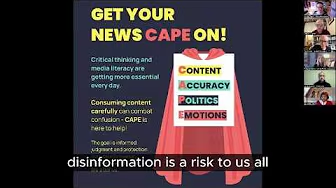
Panel discussion exploring the collapse of democratic information systems and decline in public trust.
CAPE toolkit helps users critically analyse disinformation and political bias in the media.
The video uses the term "Epstein economy" to argue that the global economic system exhibits the same exploitative and unaccountable behaviours as Jeffrey Epstein—including wealth concentration, evasion of consequences, and the manufacturing of desperation—but at a scale that human brains are neurologically ill-equipped to process or feel outrage towards.
The video argues that public obsession with individual villains like Jeffrey Epstein is a neurological trap that provides a dopamine-driven sense of justice while distracting from the systemic issues—such as extreme wealth inequality, political capture, and the "normalisation of deviance"—that continue to produce such figures.
The video argues that extreme wealth and power inevitably create "monsters" by neurologically damaging empathy systems and manufacturing a vulnerable underclass, suggesting that the only way to prevent future scandals is to dismantle the economic system that allows for such vast inequality.
The video explores how accent and class prejudice are deeply ingrained in British society, using personal anecdotes and psychological research to argue that we unconsciously equate posh accents with credibility and working-class anger with a lack of intelligence.
Professor Paul Segal explains that inflation and hyperinflation are driven by complex economic spirals.
Gary Stevenson argues that Britain is facing a return to "Dickensian" levels of inequality.
The video traces the historical rise of wealth inequality from the end of the post-WWII "golden age of capitalism" to the present, detailing how a deliberate ideological and political shift led by figures like Paul Volcker, Margaret Thatcher, and Ronald Reagan dismantled regulated markets and labor power in favour of neoliberal policies that prioritised capital and the financial sector over workers.
Creator explains his unique perspective on focusing on the psychology of poverty.
The video, produced by the Cooperation Hull collective, explores the history of the global economy from prehistoric communal living to the emergence of early states and kingdoms, arguing that modern economics is a struggle between elite domination and a more democratic system of resource sharing.
This video explains how international private equity firms capitalised on low interest rates and post-Brexit economic uncertainty to buy up major British High Street brands through debt-heavy leveraged buyouts, creating severe financial strain for these companies now that interest rates have risen.
In this video, Gary Stevenson explains how growing wealth inequality forces middle-class families to lose their property wealth through equity release and selling homes to pay for expensive end-of-life care, arguing that taxing the ultra-wealthy to fund state care services is the only way to protect ordinary family inheritances.
In this video, Gary Stevenson introduces his biographical book The Trading Game, explaining how sharing his personal journey from a working-class background to becoming Citibank’s top trader by betting on economic collapse serves as a powerful tool to reach a broader audience and drive a political movement against global inequality.
In this video, economist Gary Stevenson argues that inflation and collapsing living standards were caused by massive government spending during COVID-19 lockdowns accumulating in the hands of the ultra-wealthy, a crisis he believes can only be solved by shifting the tax burden away from working income and onto accumulated wealth.
Stevenson argues these are essentially the same mechanism of wealth transfer from asset-less to asset-holders.